
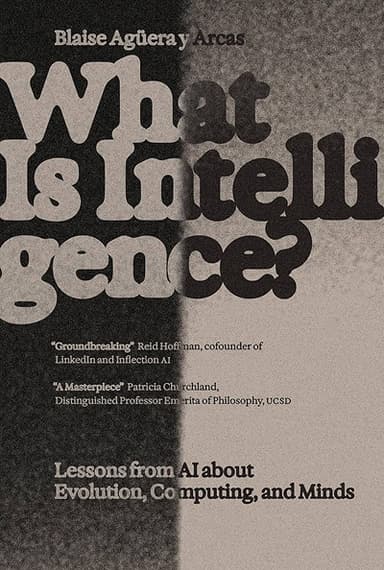
What Is Intelligence?

While artificial intelligence reaches new market valuations each week, the public conversation has become captive to spectacle. Analysts and commentators circle obsessively around the question of whether a market sustained by mutual funding between chipmakers, cloud giants, and model designers is stable enough to last. The noise of the moment muffles another reality: the existence of thinkers of AI who are directly involved in building it, and who place this technology not within logistical or industrial considerations but within biological and anthropological ones. Blaise Agüera y Arcas is one of them.
Less absorbed by data centers or venture capital than by bacterial behavior and the philosophy of language, this engineer, a pioneer of AI development at Google, has produced a six-hundred-page work that amounts to a sweeping reinterpretation of the history of life itself. He writes with the conviction that large language models represent nothing more—and nothing less—than the latest “metabolic rupture” in the evolutionary trajectory of our species.
INTRODUCTION
In 1944, physicist Erwin Schrödinger published What Is Life?, based on lectures delivered the previous year at Trinity College Dublin. In that book, this founder of quantum physics described the abyss separating our theories of matter from our theories of life. His argument, in essence, was that we lack a set of laws capable of explaining how certain molecules break from the drift toward entropy and instead assemble themselves into organized beings that act toward goals. These beings seem, at first sight, to stand at odds with the informational death that thermodynamics predicts for all physical systems.
Agüera y Arcas—CTO of Google’s Society & Technology program and founder of Pi, a research initiative devoted to AI and Artificial Life—now offers a volume pointedly titled What Is Intelligence?. He believes the time has come to address Schrödinger’s bewilderment by tracing the deep continuity at work between matter, life, intelligence, and technology. Doing so requires a broad operational framework, one capable of integrating information processing, or computation, into natural history itself.
Midway through a turbulent decade, Orson wants to share several lessons drawn from a book that is demanding yet remarkably generative, as informed as it is bold. Its main strength is the conceptual height from which it considers the question. For those who still see AI as a speculative bubble, Agüera y Arcas offers a persuasive counterargument: AI marks a turning point that deserves serious attention from today’s leaders, since it is bound to unleash a proliferation of alternative and competing futures.
LESSON I
AI IS A GENUINE FORM OF INTELLIGENCE
Agüera y Arcas argues that, despite efforts to downplay it, the AI powering today’s chatbots must be regarded as a real form of intelligence. These systems now fulfill the once-distant promise of a machine capable of sustaining an interesting conversation. In the 1950s, such a device belonged to a thought experiment (Turing’s “Computing Machinery and Intelligence”); in the 1960s, to science fiction (HAL 9000 in 2001: A Space Odyssey); in the 2010s, to something closer to a fantasy (as Siri reminded us).
When Agüera y Arcas was working on Gboard, Google’s predictive keyboard, machine learning was sometimes called artificial intelligence, but most researchers, he notes, did not truly imagine they were building AI. He himself was startled when neural architectures originally designed for visual tasks produced stunning results when applied to language. Less than a decade later, these models can pass any French baccalauréat exam and even succeed at university midterms. More recently, they have shined in mathematics olympiads. Linguistic tasks are intelligence-complete, he explains: speaking requires one to model, understand, reason, and apply common sense. As Wittgenstein pointed out, language is not a mere tool of communication; it is a way of inhabiting the world.
Agüera y Arcas rejects the denialist narrative claiming that LLMs are only simple next-word predictors. Prediction is all you need, he essentially responds. Predictive behavior lies at the core of every form of intelligence, simple or complex.
A BACTERIUM AS A COMPUTING UNIT
The bacterium represents the most basic intelligent relation to the world. Its homeostasis can be described as a projection of three functions, P(X, H, O): X denotes an external input (such as the concentration of a toxic or favorable substance in a pond at time t); H denotes an internal state derived from compressing X (hunger as a marker of need); O denotes an action (to move or not). This projection alters the initial situation, generates a new perceived state, and initiates further projections. That feedback loop, which enables even the simplest organism to survive, adapt, and persist, is the very structure of an intelligent system.
When LLMs generate answers to user queries, they reproduce this predictive dynamic at a far higher degree of complexity, much as neurons fire to help us succeed in a job interview.
There is nothing scandalous, Agüera y Arcas suggests, in the idea that a chip made of silicon and rare metals can perform tasks once thought exclusive to living beings. One might simply observe that everything alive is a computer. The founders of computation—Alan Turing and John von Neumann foremost among them—always assumed a deep correspondence between life, intelligence, and machines. In 1948–49, von Neumann even anticipated the discovery of DNA by studying how a machine might reproduce itself[1]. In his thought experiment, a machine A need only be capable of executing a program B to assemble another machine A′, to which it attaches a copy B′, enabling it in turn to replicate itself. Three elements are required: a code, a constructor, and a copier. Watson and Crick essentially uncovered the same structure when describing DNA.
This point matters because it frames Agüera y Arcas’s worldview. It allows him to move seamlessly from matter to life, from intelligence to AI. His answer to Schrödinger is that the second law of thermodynamics must be complemented by an account of what, within certain systems, copies itself, reproduces itself, and grows. Such processes amount to computation structuring matter itself. Computationalism, in his view, is a form of functionalism: if the essential operations of life or thought are carried out by a machine, they satisfy the criteria of life and thought. The problem of AI resembles that of an artificial heart or kidney. Once the machine performs the role expected of the natural organ, it earns its name.
Matter, he concludes, is a physical reality but also a program. Within any system governed by the second law, something copies itself, reproduces, and grows: a computational process shaping what exists. Over time, that process becomes more complex, life and intelligence multiply, and new thresholds emerge, the metabolic ruptures that punctuate evolution.
LESSON II
AI AS A METABOLIC RUPTURE
Materialist thinkers long held that labor is the relation through which humans regulate their metabolism with nature by means of their own activity, as Karl Marx put it. Agüera y Arcas extends that idea well beyond the human sphere. For him, every living and intelligent organism maintains such a metabolic relation with its environment. Each time the terms of that relation shift in a fundamental way, a metabolic rupture occurs.
Love (Eros) and death (Thanatos) mark two early stages in the increasing sophistication of life and intelligence. One billion years ago, when sexual reproduction emerged, intelligence ceased to be monological and became dialogical. The basic organism, previously concerned only with stabilizing its internal state against an indifferent environment, now had to recognize life itself. Living beings began identifying members of their own species, distinguishing potential partners from rivals, modulating their behaviors in response to signals emitted by other intelligent creatures.
Five hundred million years ago, another eruption of intelligence took place. Fossils from the Cambrian suddenly display eyes, beaks, shells, scales, claws. The possibility of killing and being killed prompted the evolution of visual systems, fast neural circuits, attack and escape patterns, and associative memories able to recognize recurring forms. Thanatos, in turn, encouraged reflexivity. A predator anticipates its prey’s movements more effectively when it can imagine itself in the prey’s position. A fleeing animal may attempt to mislead its pursuer. Intelligent organisms began forming increasingly sophisticated internal models of one another, much like the Portia spider still found in Asia, Africa, and Oceania. To prey on other spiders, Portia imitates the vibrations produced by its victims’ preferred sources of food, observing them with meticulous attention before striking.
BIRTH OF LANGUAGE, BIRTH OF THE MACHINE
The story of human and cultural singularity begins to take shape one hundred million years ago, when organisms ceased to live solitary lives and formed collective entities. Fifty thousand years ago, symbolic language triggered a cultural explosion among Homo sapiens communities. Social intelligence transformed the stakes, because, as Agüera y Arcas writes, theory of mind is mind. Gorillas develop powerful brains not mainly to strategize against prey but to manage life in groups, the success and wellbeing of their society. At this point in evolution, modeling others becomes a selective advantage, individually and collectively. It helps in rivalry but above all in cooperation. For Agüera y Arcas, consciousness emerges from this relational fabric. It arises from the idea of self that one inevitably forms when trying to anticipate the behavior of other minds that constantly scrutinize one’s own.From then on, major transitions have occurred at the intersection of intelligence, life, and technology.
Sedentarization, between roughly 10,000 and 3,000 BCE, led to the first cities, writing systems, fundamental sciences, forms of social differentiation—in Max Bennett’s words, a singularity already accomplished. In the mid-eighteenth century, another sweeping transformation unfolded with the rise of machinery, made possible by the steam engine and the harnessing of physical laws to generate labor.
As early as 1685, Leibniz—one of the intellectual ancestors of artificial intelligence—anticipated a time when mechanization would extend beyond physical drudgery. It is unworthy for the hours of eminent men to be consumed by servile calculation, which a machine could carry out with ease[2]. By freeing time and creating benefits that could be redistributed, the Industrial Revolution allowed a growing portion of humanity to devote itself to creative and intellectual pursuits. Now that machines themselves exhibit creativity and intellectuality, humans must confront the challenge of finding their place within a new metabolism in which cognition is no longer exclusive to them.
LESSON III
THE WORLDS OF TOMORROW WILL PASS THROUGH AI
In a recent interview, Agüera y Arcas explained that he does not believe in an antagonism between AI and humanity, because AI is our own creation. It is fed by everything humans have said, felt, experienced, and thought across the centuries. AI is a common good. Even if it may one day allow individuated robots to emerge, it appears first as a general intellect. The concept, familiar from Averroes’s medieval commentary on Aristotle’s De Anima, takes on renewed relevance in the age of AI. It reminds us that humans do not think solely with their individual minds. They think with the accumulated body of human knowledge, stored in forms that exceed any single person. Language is the medium that allows this collective store to be shared. Through language, AI now connects to the entire range of human experience, from the most demanding concepts to the most refined aesthetic sensibilities—from the intricacies of emotional life to the subtleties of wine and coffee, about which writers have long waxed eloquent.
This general knowledge, which until now lived only in individual brains, each bearing its own limited memories of the universal library, has become an active entity with which one can interact. If this hypothesis is right, we must admit that, like water or air or any natural resource, AI is a common good whose management requires end-toend responsibility, both upstream, in terms of its design, and downstream, in terms of its uses. Because language is not only the most powerful and universal instrument for acting upon the world but also a world unto itself, the fate of our values is tied directly to the governance of AI[3]. The geopolitical arms race already underway makes this point brutally clear.AI is a common good whose management requires end-toend responsibility, both upstream, in terms of its design, and downstream, in terms of its uses.
A TECHNOLOGICAL TRANSFORMATION IMPLIES A CULTURAL MACHINE
The reassuring news, for those willing to face it, is that AI may invite us to move beyond what anthropologist Joseph Henrich called the WEIRD[4] worldview: Western, Educated, Industrialized, Rich, Democratic. This worldview—carrier of major modern ideas and undeniably a vector of progress—rests on a dualism that, in Philippe Descola’s sense, draws a sharp line between a continuous physical world and an interior one thought to be exclusive to humans. Although this dualism underlies the sciences that helped give rise to AI, recent research suggests that the potential of AI cannot be fully unlocked without reactivating alternative forms of world-relation, rooted in long histories and non-European anthropologies. In Beyond Nature and Culture, Descola discusses animism, totemism, and analogism. Ethan Mollick, in Co-Intelligence (2024), shows that speaking to a machine now requires us, even though the machine has no consciousness, emotion, or sensation, to act as if it did. No one will go far by treating AI as a diligent intern. The twilight of the WEIRD world marks the emergence of a new kind of talent.
In a previous review devoted to Power and Progress by Nobel laureates Daron Acemoğlu and Simon Johnson, Orson emphasized the central importance of machine utility (MU) whenever innovation arises. A technology may serve merely as a substitute, performing less effectively what humans already do cheaply, or it may spark synergies that transform productivity and release a non-trivial quantum of free energy capable of being channeled toward new tasks. What will we do with these new possibilities? The question is hardly new. Since the early spread of soulless machinery, Robert Owen wrote in the nineteenth century, workers have been treated, with few exceptions, as secondary and subordinate machines, and more effort has gone into perfecting wood and metal than into perfecting human bodies and minds. The fact that the machine, after gaining a body, may now be gaining something like a soul does not justify neglecting the bodies and minds of those who brought it into being.
Digesting, metabolizing the rupture brought by AI is a task for humanity. Only choices made with lucidity, in which we commit both our bodies and our minds, will allow us to shape a future worthy of tomorrow’s living beings.
CONCLUSION
LIFE + INTELLIGENCE = INTELLIGENCE²
This equation captures the theorem by which Agüera y Arcas responds to Schrödinger. It states that as the computational process embedded in matter develops, life expands and grows more intricate, and the world becomes more complex. The emergence of intelligence calls forth new explosions of intelligence, occurring ever more frequently.
While today’s AIs are not yet embodied or individuated, we have crossed the threshold at which a machine can learn representations of the world, transform them with a plasticity comparable to that of a biological agent, and model futures arising from its interactions with other intelligences.
EXITING THE RUSH
Uncertainty over the real or presumed gains of AI has pushed organizations to adopt it instrumentally. An infamous recent MIT report[5] noting that ninety-five percent of generative AI pilots over the past three years failed to produce a positive financial effect has reinforced this defensive posture. Prudence and quick wins can deliver genuine competitiveness gains, yet Agüera y Arcas reminds us that the real question of artificial intelligence lies at a far higher level: exploration.
AI is the terra nova of the twenty-first century, a landscape still covered with untouched zones of potential innovation, a place whose mapping demands time, risk, and long-term vision. Those who dare disruption rather than imitation will stand at the frontier of tomorrow’s world. The point is never simply who consumes whom, but what symbioses—and what worlds—may arise from an unexpected encounter.
[1] 1. John von Neumann, Theory of Self-Reproducing, Automata, 1966 (1948-1949).
[2] 2. Gottfried Wilhelm Leibniz, Machina arithmetica in qua non additio tantum et subtractio sed et multiplicatio nullo, divisio vero paene nullo animi labore peragantur, 1685.
[3] This remark by Agüera y Arcas, alongside remarks on Gibson's concept of affordance, is worth dwelling on: Language, then, is not only a compression scheme for the umwelt, but also an umwelt in its own right, for in its capacity to model people and all they do, it includes the ability to influence or cause others to act. When you say to someone across the table, "Could you please pass the salt?",_ you are using language itself as a form of motor control to affect your environment. In fact, although indirect and totally reliant on others, language is the most powerful possible kind of motor control, since it is general-purpose enough to request anything imaginable._ (pp. 357-358)
[4] The WEIRDest People in the World, 2020.
[5] MIT, The GenAI Divide: State of AI in Business, 2025.