
The Divine Economy

July 8, 2022. Nara, Japan. In the middle of an election campaign, former Prime Minister Shinzo Abe is struck by two bullets. During questioning, the suspected assassin, Tetsuya Yamagami, reveals the motives that drove his act. He targeted Abe to make him pay for his alleged ties with the Korean Unification Church, an evangelical organization considered by many watchdogs to be a cult, known for its aggressive strategies in recruiting both followers and resources.
The story of Tetsuya Yamagami is significant in several ways. It shows what can happen when religions fail in their mission and abuse their power. But it also reveals the very levers on which religions build their success. Because they have the power to create and sustain communities, religions speak to our highest aspirations and to our most real vulnerabilities.
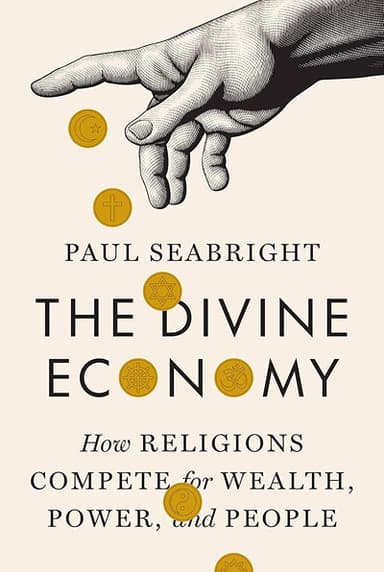
For better or worse, we are not done with religions. They reach us from the depths of time and will continue to shape history. The Divine Economy: How Religions Compete for Wealth, Power, and People, by Paul Seabright, seeks to understand the sources of their past power and why they adapt so well to our present era.
At a time when the economic and social model on which we rely is beset by crises and uncertainty, it seems wise to draw inspiration from millennia-old organizations. Orson has drawn a few lessons worth sharing: the first is a piece of context, the second an entrepreneurial insight, the third a powerful ideal.
Lesson 1: Religions are here to stay
In the United States in 2016, the combined revenues of all religious organizations exceeded the combined revenues of Microsoft and Apple. They also amounted to 60% of the media and entertainment industry’s revenues, and half of the restaurant sector’s takings. Clearly, religious institutions know how to speak to the many; to attract followers, resources, and power.
We can thus view religions as entities addressing rational economic agents. The premises for such an analysis were already laid out in Book V of An Inquiry into the Nature and Causes of the Wealth of Nations (1776), where Adam Smith noted the competitiveness of Methodist, Lutheran, and Calvinist movements that thrived outside the monopoly of the established Anglican and Catholic churches, fighting their battles with the tools of persuasion. Smith argued for the autonomy of the religious sphere and maintained that healthy competition between faiths, in an open and undistorted market, should lead to their gradual improvement.
Far from Eurocentrism, and relying on data rather than a declinist imagination, Paul Seabright demonstrates the vitality of religion on a global scale. The World Religion Database, run by Boston University based on census data since 1900, and the World Values Survey, conducting polls since 1981, establish two important facts.
First, while atheism and agnosticism seemed to spread until the late 1960s—rising from 7% of the world population in 1950 to 20% in 1970—they have declined ever since, standing at 11% of the global population since 2020.
Second, the level of religiosity worldwide has remained stable for forty years, though with strong regional disparities. Over 70% of Africans and Latin Americans say religion is very important to them, compared with just 25% of Europeans.
The main explanatory factor for these trends is demographic. Islam accounted for 12.4% of the world population in 1900; it now claims 24.4% of adherents. Over the same period, Christianity fell slightly from 34.5% to 32%. Whereas Christianity was concentrated in densely populated areas that had already undergone demographic transition, Islam was rooted in regions yet to experience it. The rise and fall of atheism, the stability of Christianity, and the growth of Islam are explained more by systemic dynamics than by ideological propaganda. Religious communities are stable entities, well-organized over the long term.
Another key factor for the future of religion lies in our entry into an era of demographic convergence, with fertility rates below the replacement threshold of 2.1 children per woman in many countries. This affects both atheist countries, such as China since its one-child policy, and deeply religious ones, such as Iran. Without secularizing, Iran has seen its fertility rate plummet once women gained access to education and employment. The long-standing dominance of religions once rested on conquest; in the 19th and 20th centuries, it was grounded in population growth. But looming demographic stagnation opens a new era in which competition between faiths will be decisive.
The apparent stability of Christianity is instructive. Official Protestant and Catholic churches have given ground to decentralized, charismatic structures—evangelical and Pentecostal alike. This shift has compensated for demographic projections: based on 1900 statistics, Christianity should have represented 26% of believers in 2020, not its actual 32%. Hinduism, too, appears to be renewing itself to fit the 21st century. Indian Prime Minister Narendra Modi’s Bharatiya Janata Party (BJP) uses the traditional religious system as a political asset, tapping into a community dynamic powerful enough to fuel vast electoral campaigns.
To understand this renewal, we must look more closely at the field on which religions wage their battles. We then discover that competition in the religious marketplace has long been competition between platforms.
Lesson 2: Religions are platforms
Hinduism spreads as a New Age version in the West, and as a social force in the Indian subcontinent. Evangelical pastors drive Mercedes and become CEOs, like millionaire Franklin Graham. Islamic movements use social media. All this logically follows from the fact that religions rank among today’s major platforms. Though the concept may sound modern, its reality predates our latest communication technologies—and religions may well be the archetype.
Like Facebook, Amazon, or BlaBlaCar, a religion is a matchmaking structure. Such organizations, Seabright explains, cover their operating costs by appropriating part of the value they help create. This matchmaking operates through a set of nodes—junctions where believers’ social, economic, and spiritual lives unfold inseparably. Just as Airbnb is more than a marketplace, enabling hosts and travelers to connect and share meaningful experiences, a synagogue, mosque, or Hindu temple aims at spiritual salvation while also offering opportunities to meet local actors, seek protection, conduct business—in short, to live all dimensions of life.
A religious platform always offers a bundle of both material and spiritual services, ostensibly free of charge, financed by more or less direct contributions. Almsgiving (zakat), along with prestigious voluntary endowments (waqf), allows the community gathered around a mosque to benefit from basic social protection, shielding its most vulnerable members from poverty by granting them access to healthcare. Historically, the synagogue marked a break from traditional temples: it moved early away from sacrificial rites and added, alongside its role as a place of worship, the provision of high-level education to a broad public.
Through such inventiveness, religious platforms have mastered the art of generating flows—and profiting from them. This explains the growing convergence between political power and spiritual authority. Even though Seabright warns religious platforms against the peril of political compromise, citing the example of Francoism and Spain’s subsequent dechristianization, it is clear that religions around the world increasingly forge alliances with public authorities, in forms reminiscent of the collaborations of tech giants such as Meta, X, or Telegram.
The ability of religious platforms to derive wealth and influence from serving the poorest is also grounded in deep knowledge of each community member’s needs. In today’s age of data and AI, platforms can scrutinize the preferences of their followers. But the success of religious platforms demonstrates a centuries-old mastery in this field. Seabright tells the story of Grace, a young woman selling bottled water at intersections in Accra, Ghana. Twelve percent of her hard-earned weekday income goes to her parish every Sunday. In return, she is rewarded. Perhaps better than Grace herself, the church knows that her country’s social stratification mistreats her, and that she needs to feel useful to regain her dignity. The pastor makes sure to acknowledge her and give her responsibilities. She greets parishioners and teaches Sunday school for free. She benefits from the organization while serving it—and also reaps implicit rewards. Research shows that religious communities are formidable matchmaking platforms, applying Richard Serra’s principle: if something is free you are the product.
Because they have long been attuned to the indirect levers of value creation, and because they know their followers’ needs intimately, religious platforms thrive in an age of change and connectivity challenges.
Lesson 3: Platforms understand community
The pursuit of the common good, the building of a durable culture, and the concern for meaning characterize religious projects that transcend the short term. Unlike states, which embody coercion, or markets, which drive atomization, religions sustain the utopia of community.In 750 AD, the Roman Catholic Church owned a third of Europe’s farmland—far from the frugality of the early Christians. Similar accumulation is documented in other religions and seems to have been central to most cults created during the so-called Axial Age. These religions (Judaism, Zoroastrianism, Confucianism, Hinduism, Buddhism) offered more than new dogmas or deities: they offered a unified vertical of life, accompanying the individual from birth to death and beyond. The Church thus gave Roman patricians haunted by decline the chance to invest their wealth in a project meant to endure across ages.
In the early 20th century, a French automobile company also understood that its product could encompass an entire way of life—if it built the ecosystem. In 1900, it launched a now-famous gastronomic guide, and in 1926, its immortal travel guides. Observers note: platform economies rely on symbiotic relationships between disparate elements destined to grow together. Their growth is based on mutualization.
Religions also possess an inspiring capacity that fuels vibrant cultures. This comes through in the adoption of bridges between heaven and earth, long-term vision and present circumstance—in other words, rituals. Business has already learned much from religion: it has its own ceremonies, economic forums, sporting competitions, contemporary art fairs, and fashion weeks. It even finds its eschatology in the looming climate catastrophe. Rituals, let’s say, provide two main services: they act as a filter, regulating community membership and its reciprocal obligations; and they foster patience. While awaiting salvation, they give people something to do. That was Pascal’s point: since grace is beyond our control, we can focus on the mechanics, oil the machine, spare ourselves no genuflection, and avoid harmful idleness. Culture is behavior.
The final point is meaning. Religions are a matter of vision. Adam Smith noted, with both wit and relevance, that they prepare people not to be good citizens in this world, but to live in the next. In an age of AI, of “bullshit jobs,” and the return of war, we should draw from this capacity to enchant, and give each person a mission through which they can fully realize themselves. Brands are investing in this terrain to build communities. A maker of technical clothing sells gear while encouraging customers to repair rather than replace items, and runs recycling programs. It also donates part of its revenue to environmental organizations. Choosing this brand means working for a cause, stepping into a timeline that extends beyond the purchase.
Similarly, luxury brands that are thriving in the current crisis are not followers but shapers of perception. To an economy driven by impulse and consumption, they prefer the crafting of a myth accompanied by selective rituals. When Seabright asks how religions succeed so well at meeting people’s needs, often so hard to satisfy, he emphasizes that humans flourish in activities with a collective dimension. “Religious platforms,” he writes, “know precisely how to create communities that connect our lives to that dimension.”
Paul Seabright’s Divine Economy sheds light on the endurance of religions as platforms capable of uniting, giving meaning, and meeting the needs of their communities in an age marked by uncertainty.
The millennia-long trajectories of religions illustrate the prosperity of the platform model. Leaders would do well to draw inspiration from their ability to spread rituals, forge narratives, and structure collective life, with the aim of building genuine communities. Flexible strategies, wide integration, and value-sharing are all ways to invent its material counterpart.
In an age of polarization, this model seems the best suited to building sustainable growth, overcoming social divides, and transcending immediate interests.
The art of enchanting the world.